
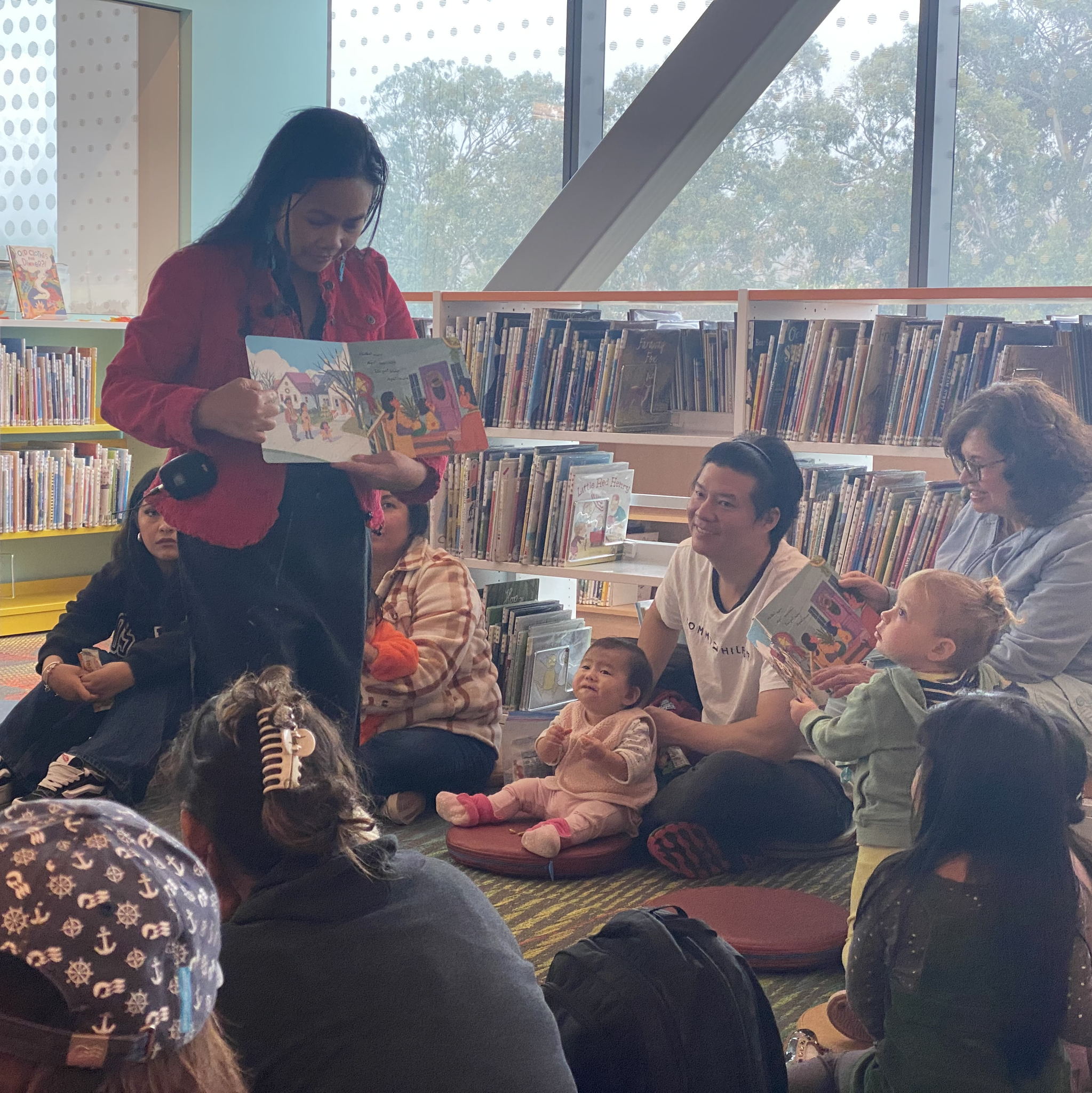
Justine reading to children at South San Francisco Library
Cultivate is a Foundation program that aims to nourish connection and collaboration among Black, Indigenous and People of Color (BIPOC)-led local nonprofits and close pervasive fundraising gaps that affect them, their organizations, and the communities they serve. One of the leaders in this year’s cohort is Justine Villanueva, Founder of Sawaga River Press and Libro Para Sa Tanan, A Literacy Project.
Building From Scratch
For Justine, understanding and connection are key parts of the Cultivate experience. “My Cultivate mentor and peers understand my joys and challenges of building a nonprofit from scratch, with the BIPOC communities of which we are all part,” Justine shared.
Among the opportunities Cultivate presents is the space to reflect on philanthropy through a decolonial lens and dream about a more equitable future. “I really appreciate having a very informative mentor with whom I can discuss not just the nuts and bolts of building a nonprofit from the ground up, but also the bigger question of what it means to be a sustainable nonprofit in a capitalist economy,” she shared.
Justine connected with her cohort peers through honest conversations about the challenges of leading a nonprofit. Together, they shared resources and tips on how they overcame struggles with fundraising, databases, social media, board members, and burnout. “I could sum up my experience by saying that I have gained perspective of my nonprofit publishing work as a calling that I need to do sustainably,” Justine concluded.
Social Justice, Belonging, Flourishing, and Kapwa
Sawaga River Press publishes multilingual children’s books that feature Filipino American kids in the diaspora, a group of people who share a cultural and regional origin but live away from their traditional homeland. Sawaga River Press values social justice, belonging, flourishing, and kapwa, an indigenous Tagalog word that can’t be translated directly to English.
Sawaga River Press describes kapwa as “the indigenous Filipino spirit that connects us with our human and more-than-human relatives.” Virgilio Enriquez, founder of Sikolohiyang Pilipino (Filipino Psychology), described kapwa as a shared identity, or an inner self shared with others. Community elder and leading kapwa practitioner Leny Strobel explained that it is a “a sense of connectedness with one another.” Across interpretations, kapwa always points back to being deeply connected to your community, to seeing yourself in others and others as an integral part of yourself. Kapwa is a core tenet of Filipino culture, of Sawaga River Press’s values, and, by extension, of Cultivate.

Justine Villanueva with copies of her first book, Mama, Mama, Do You Know What I Like?
The Hard and Joyful Journey
Justine founded Libro Para Sa Tanan, A Literacy Project,in 2008 with her sister and husband to promote literacy in Bukidnon, her hometown in the Philippines. Five years later, when looking for books to read to her kids, Justine saw a lack of representation for Filipino American children and families.
Inspired by community need, Justine broadened the nonprofit’s mission and began publishing children’s books. They named their press in honor of the Sawaga River, a tributary of the Pulangui River that runs across Bukidnon. In 2017, Sawaga River Press published its first trilingual children’s picture book, Mama, Mama, Do You Know What I Like? In addition to publishing, Sawaga River Press presents its books to schools and libraries and donates books to community organizations to promote language, literacy, and cultural reclamation.
Despite widespread negative misconceptions about self-publishing, Justine had one mission: to write a story in her first language, Bisaya, that memorialized her fleeting time with her sons, who were then five and two years old. “I wrote my story, raised money, hired an illustrator, worked with a printer, tapped a bunch of family and friends for help, created a nonprofit small press, and learned a lot about the decades-old struggle for equity and diversity in publishing stories.”
Although proud of her small, independent press, Justine had some doubts about its legitimacy in comparison to traditional publishing, which touted wider reach, larger production capabilities, and name recognition. Justine shared that she thought, “I could be writing stories instead of hustling—mailing books, attending grueling book events, calling bookstores, and driving around with boxes of books in my trunk.”
To still those doubts, Justine spent years learning about traditional publishing—attending conferences and workshops, paying for editorial critiques, and pitching her stories—until she realized that she loved the hustle of publishing all along. “It pushes me to reach out to and strengthen my relationships with my kapwa, create community, and be in this hard but joyful journey together to tell our stories and, in the process, heal the colonial wounds that manifest in our separation from our indigenous selves and ways of being.”
Justine also learned to let go of the idea of “self-publishing.” “Let’s call it what it is: community publishing,” she said. “I’m engaging my community to publish stories by, about, and for us. There is sovereignty in this kind of publishing. And it’s beautiful, regenerative, and liberatory.”
Justine’s journey with Sawaga River Press is exactly the kind of community-rooted leadership Cultivate was designed to support. She saw a need in the community and, like so many Cultivators, responded by building something that preserves culture and strengthens connections with others. She didn’t just fill a gap in representation; she reimagined what publishing could look like when powered by purpose and collective cultural memory. This echoes the spirit of many Cultivate leaders—individuals who work with deep intention, who know that systems change involves personal truth and communal healing, and who come together in vulnerability and honesty to lift each other up.
While there are many parts of the work that Justine enjoys, what excites her most is building and being part of a community. “I love collaborating with people who feel how I do about remembering our indigenous stories and myths, honoring our ancestors and elders, highlighting our Filipino American history, and sharing our lived experiences,” she shared. “I feel right being part of a bigger whole, doing what gives me joy while contributing to our healing, belonging and flourishing.”