
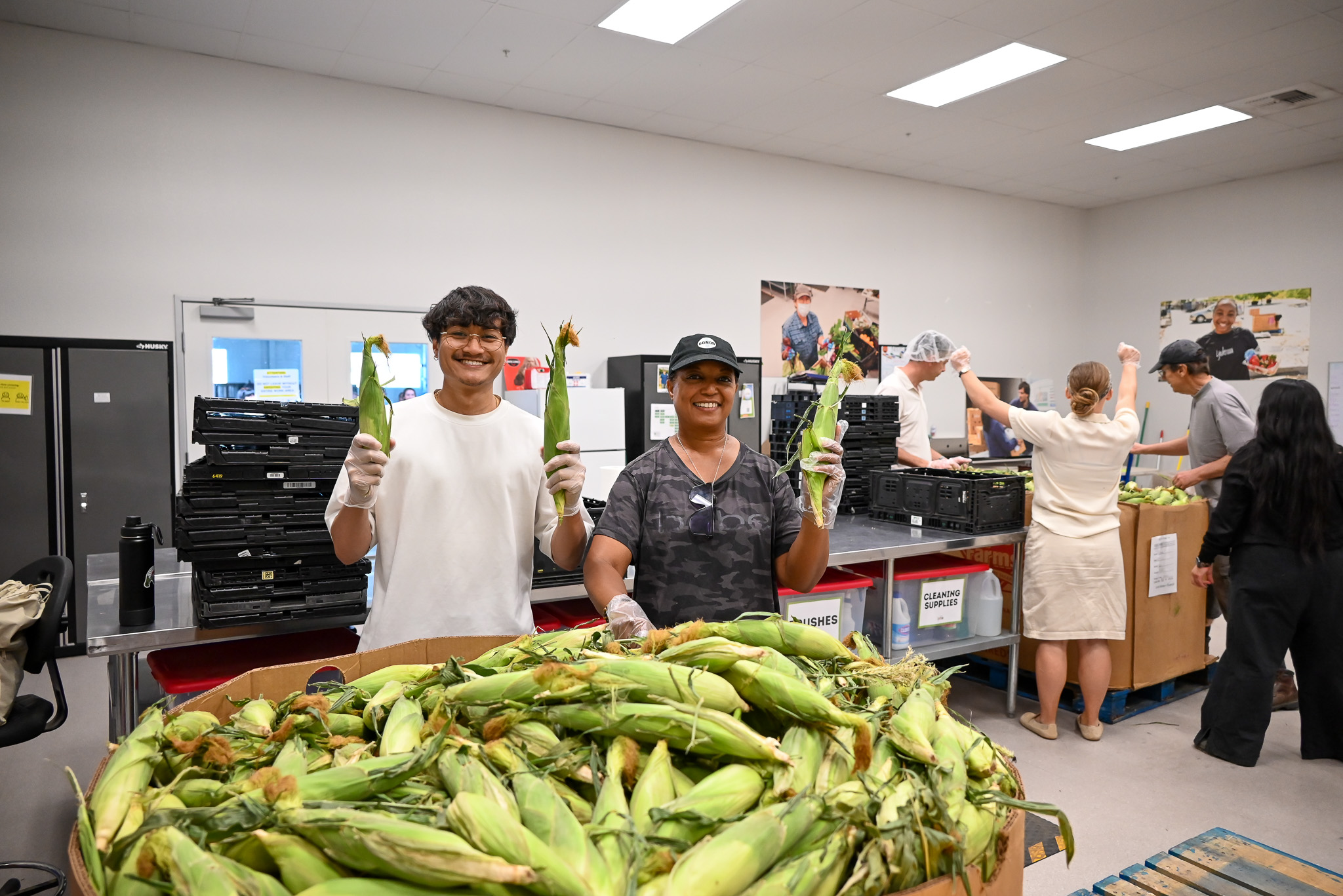
Yolo County is one of the most productive agricultural regions in the country. Its farms grow tomatoes, rice, sunflowers, and dozens of other crops that feed people across the state and beyond. And yet, one in three families here struggles with food insecurity.
That contradiction has always been at the heart of why the Sacramento Region Community Foundation made one of the largest grant commitments in our history to Yolo Food Bank: Food is abundant in Yolo County, but the systems that move it from fields to families have too many gaps.
A year into that investment, I want to share what’s changed.
When Farmers and Food Banks Work Together
Yolo Food Bank’s Harvest Program set an ambitious goal: Connect with 50 to 60 new farm partners, host up to 30 gleaning events, and contribute to a three-year target of 500,000 pounds of produce.
It exceeded nearly every one of those goals — in year one.
Fifty-five new farm partners joined the network. Fifty-three gleaning events were held, surpassing both the year-one goal of 30 and the year-two goal of 45.
And the produce totals tell the clearest story: The year before the Harvest Program launched, Yolo Food Bank received 200,052 pounds of produce from farms. This year, the number more than doubled to 492,512 pounds. That produce reached an estimated 32,834 households, with 380 volunteers showing up to help glean it.
Yolo Food Bank has also contracted with five local farms to grow crops specifically for the food bank — broccoli, tomatoes, peppers, okra, and more. More than just receiving what farmers have left over, the Harvest Program is now part of what farmers plan for.
At Yolo Food Bank’s annual appreciation event this spring, John Wilcox of Alemaya Farms in Guinda accepted the New Farm Partner award. Standing in the warehouse, he talked about how meaningful it was to see the scale of the operation in person, and to know the produce he was growing was helping people in his community who needed it most.
While John didn’t start farming to feed a food bank, once he saw what was possible, he wanted to be part of it. That’s what this program is building alongside the numbers: a community of farmers, volunteers, and food bank staff who see each other’s work and want to show up for it.
Food insecurity in Yolo County is not a simple problem, and no single grant solves it. But when you invest in trusted organizations and stay committed for the long term, the results compound. More farms. More food. More families reached.
That’s what the donors who give through our Impact Fund are making possible. If you’d like to be part of this work, learn more about giving through our Impact Fund — or consider joining the Impact Collaborative, our giving circle for people who want to give, gather, and help direct grants right here in the Sacramento region.rust. We’re grateful to the donors whose generosity through our Impact Fund made this work possible, and to the Yolo Food Bank team for making the most of every dollar.
Make Your Impact
Support efforts like this with a gift to the Impact Fund. You can also join the Impact Collaborative, a network of people who care about this community and want to make a difference alongside others who feel the same.